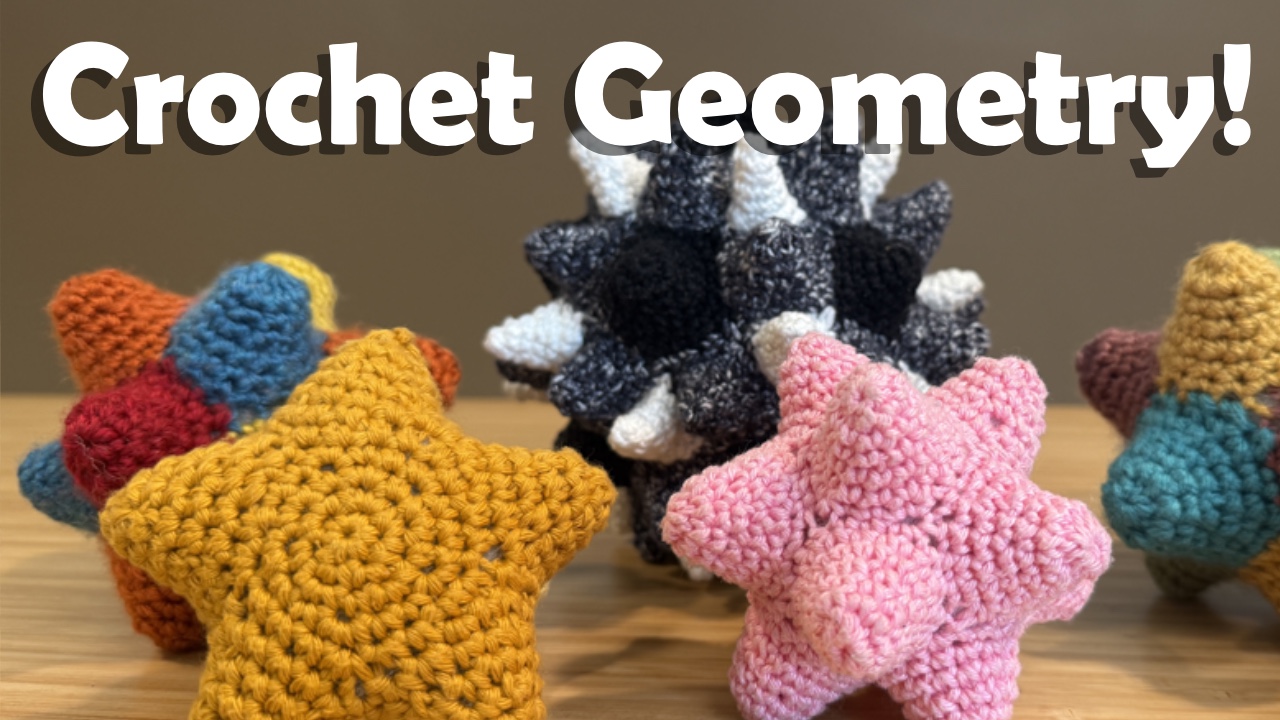
Over the past few months, I’ve been messing around with a technique that allows me to crochet spiky versions of geometric shapes. I’ve found this really fun to work with, and wanted to share the technique so that others can also experiment with it!
I’m not claiming to be the first person to make something like this- I found this Berocco pattern from this page on the MOMATH site after messing around with my own version for a bit. I just want to share my personal approach to this sort of thing in the chance others find it useful.
The crochet stitches used to create this are all pretty basic, but the application of them could get tricky if you aren’t comfortable with freehanding your crochet projects or otherwise not working from a pattern. I do my best to spell out every step you need to take here, but this truly is meant to be a crochet technique tutorial and not a pattern. I’ll be explaining the process using an example in this tutorial, but that example only covers one possible application and approach!
This is also a fairly mathematical technique! I’ve done my best to keep all the math as simple as possible for those of you who aren’t as into it as I am, but you will need some understanding of basic shapes and geometry terms here. I’ve split the math into two sections as well: the basic stuff you need to get started with this technique, and the more in depth math and other suggestions for those of you who want to really take this idea and run with it.
There is also a video version of this technique available here on my YouTube channel, if you feel you learn better through video.
If you’re sticking around with the post version of this tutorial, we’ll get started by talking about the stitches used for this technique!
Part 1: The Stitches
The stitches you need to know for this technique are single crochet (sc), foundation single crochet (fsc), and the invisible decrease (invdec). You can also do this technique using a traditional single crochet decrease, but seeing as we’re working in continuous rounds like we would with amigurumi, an invisible decrease is a little more useful here.
You’re also going to want to know how to use a foundation single crochet to work from existing stitches, and technically how to do a standing single crochet as well. If you don’t know what that is, it’s essentially a single crochet into an existing project with a slip knot of new yarn on your hook.
I’ve linked all the tutorials necessary below, in both right and left handed formats depending on your preference.
Technique overview
Before we get into the math, I want to do a quick overview of how this technique works so the next section makes a bit more sense. We’ll be creating a loop using fsc’s to make the perimeter of the faces of our shape. This serves as the first round of our spike, which we’ll work upwards towards the point. New spikes will be worked directly into the base of existing ones, and we’ll be using fsc’s to complete a ring going away and then back to this base, again tracing out the perimeter of the face.
When you’re ready, join me on the next page to get into the math of this technique!
Leave a Reply