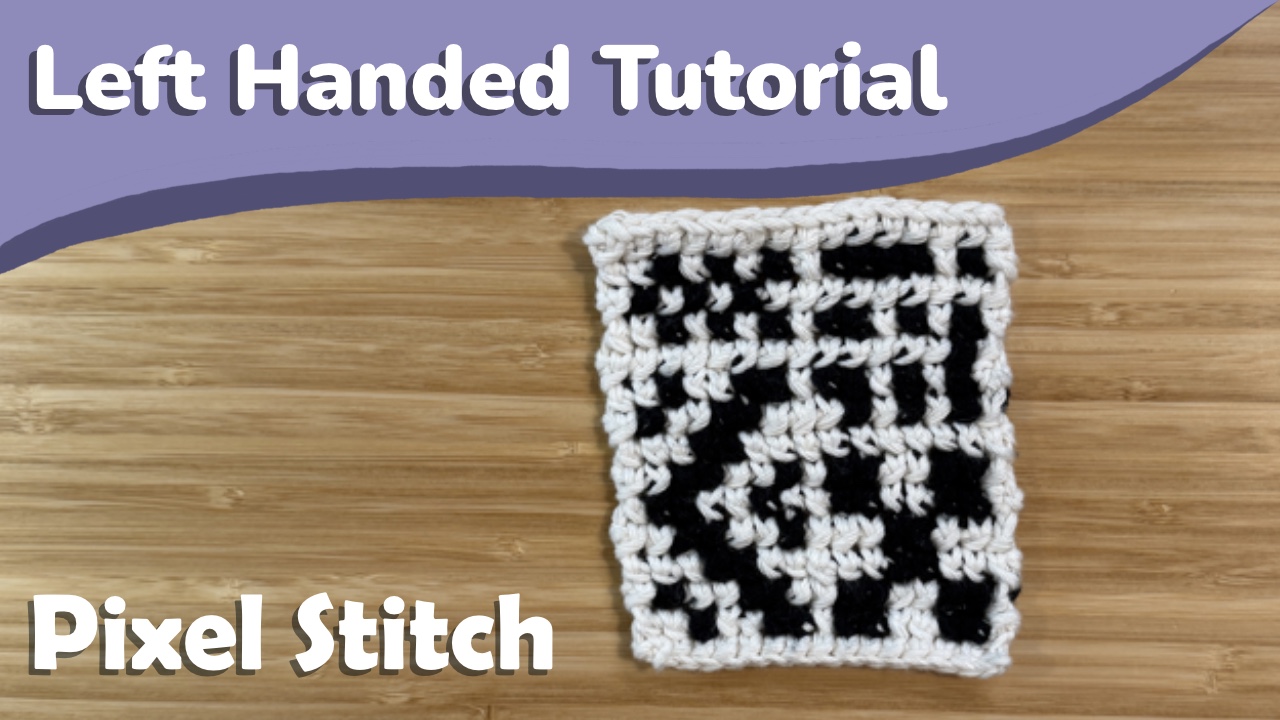
In this post I’ll be covering how to crochet what I call the pixel stitch. I came across a version of this stitch on Pinterest worked in the round, and modified it to be used mirrored in rows for crochet tapestries!
If you’re not familiar with the concept of mirror crochet, I’ve done a tutorial on a mirrored single crochet stitch that you can use to learn the concept. There may be other names for this idea, but what is essentially happening is you’re crocheting as if you were working with your non-dominant hand so the fronts of your stitches are all on the same side when working in rows. You can do this without changing which hand you hold your hook in by just going in through the back of your work on wrong side rows. I’ll show you exactly how to mirror this stitch in this post.
If you’re right handed, you can check out that tutorial here, or if you prefer a video tutorial, check that out here.
The Pixel Stitch
To begin with this stitch, you’re going to want to chain the number of stitches you want plus one. So if you want to work a row of 30 stitches, you’ll chain 31. You may want to size up your hook for this starting chain as well, since the first row tends to be a bit tighter than subsequent ones.
This stitch is worked through two stitches, similar to a decrease.
Working the first row
The first row is definitely one of the harder parts of this stitch. I’ll show you the setup, but if you’re having trouble with the stitch I recommend looking at the next section to see how the stitch is worked into existing rows- it might make it a bit easier to understand.
Make sure you keep track of the second chain from your hook. We’ll start by working around or under our starting chain to pull up a loop.


Now, go into the second chain from your hook and pull up a loop. You should have three loops on your hook at this point.

You’re now going to pull that loop you just pulled up through the middle loop on your hook.


Now, yarn over and pull through the remaining two loops on your hook.

That’s one stitch done! The starts of rows are the trickiest. To work the next stitch, you’re going to go back into the previous chain you worked into- the second chain from your hook. Pull up a loop.

Now, work into the next chain and pull a loop through this chain and the first loop on your hook.

Now yarn over and pull through both loops.

You’ll continue like this across the row- starting in the previous stitch you worked into before going into the next, unworked stitch.
Working at the start of a row
I make my first stitch also a pixel stitch worked around my starting chain and into the first stitch of my row. It’s a little tricky, but it works, and it’s what makes rows of pixel stitch a consistent length since this stitch is worked through two stitches!
This stitch has a chain one turning chain, so make sure you have that done before starting your row.
Now, you’re going to go around and behind this turning chain to pick up a loop. This is your “previous stitch” if you were working in the middle of a row.


Now go into the first stitch of your row and pull a loop through that stitch and the first loop on your hook.

Pull a loop through the two stitches on your hook.

That’s how I do the starts of my rows! It’s definitely a bit tricky, but it keeps everything looking consistent.
Working in the middle of a row
When working this stitch, you’ll be working into the previous and next stitch, just like we did into the starting chain with the first row. These stitches are marked on the image below.

Start by inserting your hook into the previous stitch and pulling up a loop.

Now insert your hook into the next stitch, and pull a loop through this stitch and the first loop on your hook.

Finish the stitch by pulling a loop through both loops on your hook.

That’s the stitch! You’ll always be working into the previous and the next stitch, so if you work in all stitches across the row, you’ll end up with one fewer stitch than the previous row. I make sure that I end with the same number of stitches as I started with by doing that modified stitch at the start of my rows.
Mirroring the Stitch (Wrong Side Rows)
When working the wrong side rows, we need to mirror the stitch to put the fronts on the same side. If this stitch isn’t mirrored, the pixels don’t work! You can find a tutorial on how to mirror a single crochet stitch here if you’re unfamiliar with the technique.
To mirror this stitch we’re going to be following a very similar process to mirroring a single crochet. Usually when you do a yarn over and pull the loop through your work, the mouth of your hook will turn towards you, or towards the front of your work. To mirror this, we’ll be inserting our hook through the back of our work and turning the mouth of the hook away from us.
Starting a mirrored row
The first stitch in our mirrored rows is worked similarly to the first stitches in our non-mirrored rows. I like to turn my work so that my working yarn is on the side of my work that’s facing me- it tends to make the first loop easier to grab in my experience.

Start by working around your turning chain to pull a loop to the back (right side) of your work. I don’t tend to worry as much about mirroring this loop properly since it’s already tricky to pull up a loop.


Now, insert your hook through the back of your next stitch.

Lay the yarn over your hook and turn the mouth of your hook away from you as you pull up a loop.


Pull that loop through the middle loop on your hook. I like to do this by turning the mouth of my hook towards me since it’s more natural.


Lay the yarn over your hook, and turn it away from you as you pull a loop through the last two stitches.


The middle of a mirrored row
Begin by inserting your hook in the previous stitch through the back of your work. Lay the yarn over your hook and turn your hook away from you to pull the loop through the stitch.


Repeat that for the next stitch. Insert your hook through the back of your work, lay the yarn over your hook, and turn it away from you as you pull it through.


Pull that second loop through the first one.

To finish the stitch, lay the yarn over your hook one more time, and turn your hook away from you to catch it and pull it through both loops on your hook.


And that’s how you mirror this stitch! You’ll be alternating mirrored and non-mirrored rows to ensure the fronts of your stitches are all on the same side.

Final notes
This stitch centers each row on top of the previous one, likely due to working in two stitches at once. This centering is most obvious when you compare a 1×1 checkerboard using single crochet and the pixel stitch (the upper right sections of the tapestries below).


If you look at the single crochet example, you can see that although the pattern was worked in a checkerboard, the resulting design seems more like zigzags.
The pixel stitch on the other hand actually shows the checkerboard that the stitches are actually worked in.
I color change with this stitch in the same way I would for any other stitch- by making the last loop you pull up in your new color. This does leave some peek through of other colors, so there might be a better way to color change that mitigates this, but I think this method still works pretty well!
These stitches are also slightly taller than square! It doesn’t tend to be super obvious, but it is something to note.
I hope you find this stitch useful in your tapestries or whatever else you use it for!
Leave a Reply
You must be logged in to post a comment.